
HOMCOM Adjustable Weight Bench Press Barbell Rack Dip Station | Foldable, Home Gym, Strength Tra
£65.99
View on Amazon →
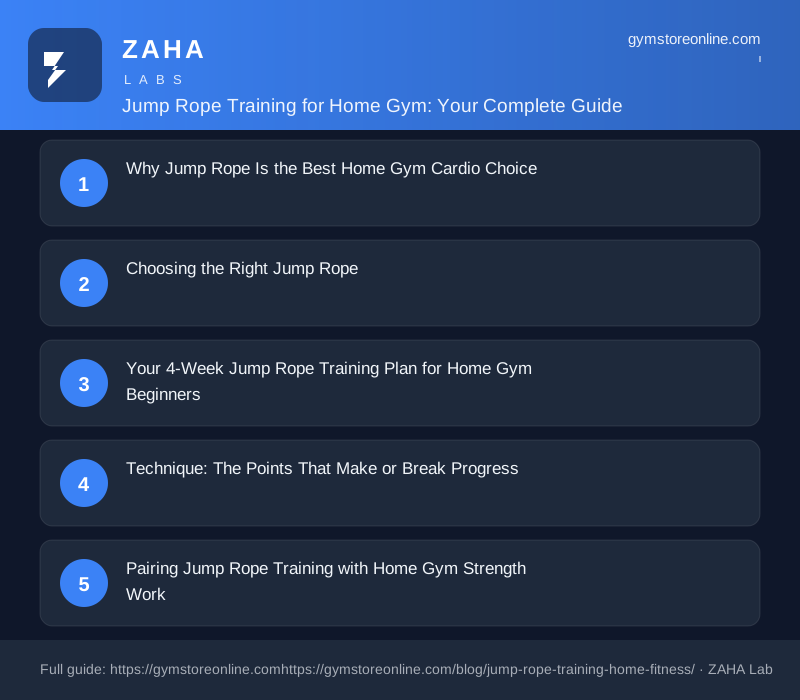
Published 17 September 2026 · updated 2026-09-17 · by GymStoreOnline
A jump rope packs into a drawer, costs less than one gym day pass, and delivers a harder cardio session than most people expect. Jump rope training for home gym workouts is one of the most space-efficient forms of cardio available — you need under two square metres of clearance, and 20 minutes at moderate pace delivers genuine cardiovascular conditioning.
The cardiovascular demand of skipping is high and arrives quickly. At a moderate pace of 100–120 skips per minute, your heart rate climbs to aerobic training territory within two to three minutes and stays there for the duration. Sprint intervals at 140 skips or above push you into high-intensity anaerobic work — without a treadmill, a stationary bike, or a rowing machine taking up half the room.
Jump rope also trains co-ordination, timing, and rhythm in a way that purely mechanical cardio does not. That cognitive engagement makes sessions feel shorter, and the foot and ankle strengthening from consistent skipping carries over into virtually every lower-body exercise you do.
The footprint comparison with other home gym cardio equipment is stark. A treadmill typically occupies two to three square metres and weighs 60–100 kg. A speed rope, coiled up, fits in a jacket pocket.
Speed ropes use a thin PVC or wire cable with lightweight handles. They rotate fast, let you build rhythm quickly, and suit cardio conditioning, fat-loss training, and learning double-unders. If you are new to skipping or returning after a break, a speed rope is where to start.
Weighted ropes add mass to the handles, the cable, or both. Handle-weighted ropes shift the effort into the shoulders and upper arms; cable-weighted ropes increase resistance throughout the movement. Weighted ropes slow your pace but increase muscular fatigue — useful as a progression once technique is solid, but a frustrating starting point for beginners.
Stand on the midpoint of the rope and lift the handles: they should reach roughly to your armpits. Most adults need between 2.7 m and 3 m. An adjustable-length rope or one with a crimping collar lets you fine-tune this. Fixed-length ropes are only sensible if you already know your exact measurement.
Getting the length wrong is one of the most common causes of early frustration. Too long and the rope drags on the floor; too short and you adopt a hunched posture trying to keep the rope clearing your feet.
Ball-bearing handles allow the cable to spin independently of the grip, which dramatically reduces the wrist torque needed to maintain rhythm. Ropes without bearings — or with cheap plastic-sleeve bearings — transfer more rotational force into your wrists and arms during sustained work.
Look for foam or rubber grip material. Check that the handle length suits your hand size — very short handles give less leverage; very long ones feel awkward during extended sessions.
If your rope has an adjustable cable, test the length in 5 cm increments and jump with each setting before trimming. Cutting the cable is irreversible. The right length gives about 5–8 cm of clearance between the rope and the floor at the bottom of each rotation.
You do not need to skip continuously to begin. The most effective beginner approach is interval-based: alternating work periods with rest. As co-ordination builds, the rest periods shrink.
| Week | Session Length | Work : Rest | Sessions Per Week |
|---|---|---|---|
| 1 | 15 min | 30 s : 30 s | 3 |
| 2 | 18 min | 40 s : 20 s | 3 |
| 3 | 20 min | 50 s : 10 s | 4 |
| 4 | 20 min | Aim for 5-min continuous blocks | 4 |
Leave at least one full rest day between sessions in the first two weeks. Jumping on fatigued calves significantly raises the risk of shin splints — the most common early complaint among beginners.
If you miss the continuous target in week four, repeat week three rather than pushing through. Consistency matters more than speed of progression.
Six fundamentals govern efficient skipping. Getting any one of them wrong adds fatigue, slows your pace, or raises injury risk.
Concrete garage floors and hard tiles concentrate impact at the forefoot. Repeated sessions without proper footwear cause metatarsal bruising, shin splints, and plantar fascia discomfort over time. Use an EVA foam or rubber gym mat — minimum 6 mm, ideally 10 mm thickness — and wear cross-trainers with forefoot cushioning rather than running shoes with a pronounced heel drop, which encourage heel-landing patterns.
Jump rope is a near-perfect cardio tool, but cardio alone does not build or maintain muscle mass. The most effective home gym structure combines jump rope conditioning with compound resistance training, usually in the same session.
A structure that works well for most people:
The resistance side of this setup needs, at minimum, an adjustable weight bench. The OZE SPORTS Adjustable Weight Bench (£39.99, 4.5 stars) covers incline, decline, and flat positions for free-weight pressing and rowing movements, and folds flat for wall storage between sessions. It keeps your total setup well under £60 — the right entry point if you are testing whether home gym training works for your lifestyle before committing to a larger outlay.
For anyone wanting to add barbell squats, overhead press, or dips, the Yaheetech Adjustable Squat Rack (£49.98, 4.4 stars) functions as a dip station and bench press support as well as a barbell rack. It handles heavier loads than a standalone bench and opens up movements a bench alone cannot accommodate. Check your available floor area before buying — the rack has a wider footprint than a folding bench.
If you are building a longer-term home gym, the YOLEO Adjustable Weight Bench (£69.99, 4.6 stars) is ASTM-certified to 300–375 kg, arrives 98% pre-assembled, and adjusts across 84–90 positions including steep decline angles. The ASTM certification matters: it is an independently tested load rating, not a figure the manufacturer has declared without external verification.
For a near-complete home gym in a single purchase, the YOLEO 400–900KG ASTM-Certified All-in-One Weight Bench Set (£99.99, 4.6 stars) adds a bench press rack, leg extension, and leg curl fixture to a certified bench. Combined with a jump rope, that covers cardiovascular conditioning, upper body pressing, lower body strength, and joint-isolation work without a commercial gym footprint.
We applied a consistent set of criteria to the resistance equipment featured in this guide.


You need roughly 1.5–2 square metres of clear floor and at least 30–40 cm of headroom above the top of your jump. In practice, that fits in most living rooms, a spare bedroom, or a garage corner. Check for low light fittings or beams overhead. A yoga mat-sized floor area is the minimum, though slightly more room reduces the chance of clipping furniture or walls while you are still building your rhythm.
Most beginners can sustain 2–3 minute continuous intervals within three to four weeks of consistent practice, using an interval approach. Achieving 10 or more minutes continuously typically takes 8–12 weeks. Progress depends on starting fitness level and training frequency — three or four sessions per week advances you faster than one. Co-ordination is usually the limiting factor early on, not cardiovascular fitness.
Jump rope alone is sufficient to maintain and improve cardiovascular fitness. However, cardio without resistance training does not build or preserve muscle mass, which matters for long-term metabolic health and functional strength. The most effective approach combines jump rope sessions with compound resistance work — using the rope as your warm-up and finisher around a core strength session on a weight bench or squat rack.
Look for a foldable design for space efficiency, adjustable backrest positions covering incline and decline angles, and a verified load rating. ASTM-certified capacity figures are independently tested; manufacturer-stated figures are self-declared and worth scrutinising. The YOLEO Adjustable Weight Bench (£69.99, 4.6 stars) covers 84–90 adjustment positions, is ASTM-certified to 300–375 kg, and arrives 98% pre-assembled, reducing setup time considerably.
As an Amazon Associate we earn from qualifying purchases. Prices and availability are accurate as of the date shown and are subject to change — the price on Amazon at checkout is the one that applies.
Find the best adjustable bench for ab and core workouts at home. UK guide covering angles, load ratings and picks under £100 for e
Everything you need to choose the best adjustable dumbbells for home workouts: weight range, locking mechanisms, build quality and
Build your home barbell and weight plate setup right: what to look for in bars, plates, squat racks and benches. Real specs, UK pr