
YOLEO Adjustable Weight Bench for Home Gym, ENISO-Certified 375KG, 98% Pre-Assembled, Foldable G
£79.99
View on Amazon →
Published 17 September 2026 · updated 2026-09-17 · by GymStoreOnline
Doing hundreds of sit-ups on a hard floor mostly trains your hip flexors, not your abs — and puts your lumbar spine through repeated compression in the process. The best adjustable bench for ab and core workouts at home changes that equation: decline and incline positions let you work every part of the core through a full range of motion, at home, for under £100.
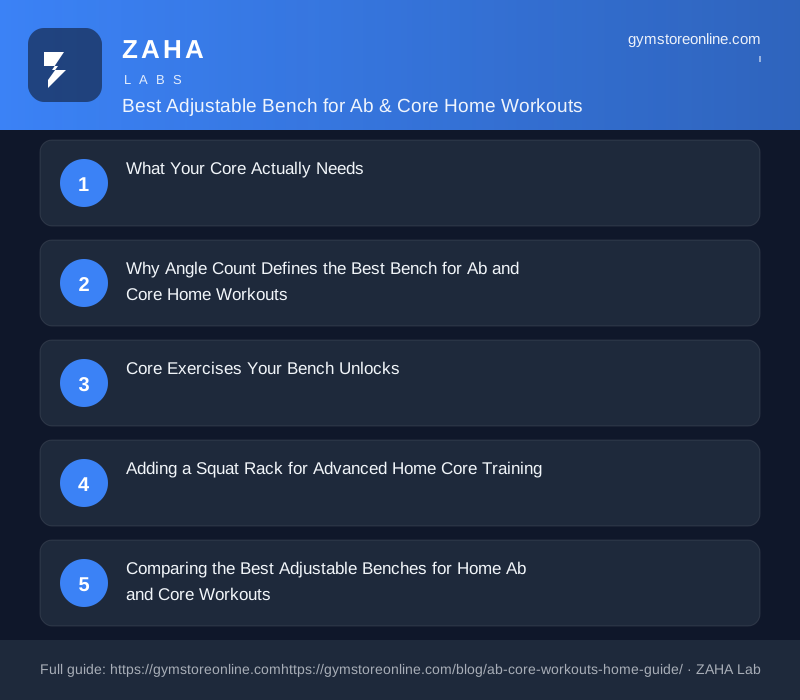
The core is not just the six-pack. A complete home programme must target four distinct muscle groups:
A mat on the floor gives you one angle: horizontal. An adjustable bench adds a decline (greater ab range of motion), an incline (less hip-flexor dominance) and a flat padded surface for loaded work with dumbbells or plates. That angle range is what separates training that progresses from training that plateaus after six weeks.
The number of adjustment positions is the most underrated specification on any weight bench. A model with just three settings — flat, 30° and 60° — skips the 15–25° sweet spot that most effectively loads the lower rectus abdominis on a decline sit-up. Look for at least six to eight distinct back-pad positions, with a genuine decline setting below horizontal rather than incline-only variants.
The YOLEO Adjustable Weight Bench (84–90 positions, ASTM-certified to 300/375 kg, 98% pre-assembled, £69.99, 4.6 stars) stands apart on this count. Eighty-four to ninety positions means you can dial in precisely the angle that challenges you — from a shallow 15° decline for beginners up to a steep near-vertical setting for seated core holds. The ASTM structural certification is third-party verified, not a self-issued manufacturer figure, which matters once you are loading the bench with added resistance.
For mid-range budgets, the Weight Bench Foldable with 67 training angles and a 74.5 cm wide seat (£59.99, 4.6 stars, rated to 300 kg) is a practical choice. The wider seat pad is a genuine advantage during oblique exercises: a narrow surface can feel unstable when your upper body rotates during Russian twists or side-bend variations.
For bodyweight-first training, the OZE SPORTS Adjustable Weight Bench (incline, decline and flat positions, £39.99, 4.5 stars) covers the three essential angles at the lowest price in this category. Confirm the full load rating in the product listing before adding any resistance; not all budget benches publish a per-position capacity figure.
Set the back pad to 20–25° decline. Complete three sets of 15 repetitions with clean form — hips level, no momentum through the lower back — before holding a 2–4 kg plate at your chest. Skipping this progression step is the most common cause of lumbar strain on a home bench.
Weighted crunch across the bench — lie perpendicular on the flat setting, lower back supported, upper body hanging free. The bench removes floor contact from the lumbar spine and lets the rectus abdominis travel through its complete range of motion.
Decline sit-up — the benchmark upper-ab movement. Anchor your feet under the leg roller pad and keep the downward phase controlled rather than dropping under gravity.
Bench leg raise — sit at the end of the flat bench, grip the side handles and raise both extended legs to horizontal. High demand on the lower rectus abdominis with minimal technique complexity to learn.
Reverse crunch — lie flat, bring knees to the chest while lifting your hips off the pad. The bench height prevents the lumbar spine from impacting the floor on the return phase.
Russian twist — set the back pad to 45°, sit with feet elevated and rotate a dumbbell from side to side. The 74.5 cm seat width of the Foldable bench adds stability here compared to narrower pads.
Side plank with feet on bench — the elevated foot position increases oblique demand relative to a floor side plank and provides a more controlled starting point for beginners.
Elevated plank — raising your feet 30–40 cm on the bench increases anterior-core demand measurably over a flat floor plank with no additional kit required.
Ab wheel rollout — kneel in front of the bench and use the pad as your progressive stopping point, moving it further away as your range of motion develops over weeks.
An adjustable bench handles the majority of core movements. Once you want to progress to hanging exercises — knee raises, L-sits and dip-to-knee-tuck combinations — you need an overhead anchor point that a flat bench cannot provide.
The TOTEBOX Adjustable Squat Rack Barbell Stand (£56.99, 4.6 stars) includes a push-up bracket, spotter arm and dipping bar. The dip station enables hanging knee raises and L-sit holds — movements that load the hip flexors and lower abs at a level no flat or decline bench can replicate. Paired with the YOLEO Adjustable Weight Bench, the combined outlay sits under £130.
For a single combined unit, the YOLEO 400–900 kg ASTM-Certified All-in-One Weight Bench Set (£99.99, 4.6 stars) includes a bench press rack with leg extension and curl attachments — giving you the barbell anchor needed for foot-hooked decline sit-ups and compound lower-body training in a single footprint.
| Model | Price | Capacity | Positions | Stars | Best For |
|---|---|---|---|---|---|
| OZE SPORTS Adjustable Bench | £39.99 | Check listing | Incline / flat / decline | 4.5 | Bodyweight core on a budget |
| Weight Bench Foldable (74.5 cm seat) | £59.99 | 300 kg | 67 angles | 4.6 | Wide-pad oblique stability |
| YOLEO Adjustable Weight Bench | £69.99 | 300–375 kg (ASTM) | 84–90 positions | 4.6 | Precision angle control |
| TOTEBOX Squat Rack + Dip Bar | £56.99 | Heavy duty | Spotter arm + dip station | 4.6 | Hanging core movements |
| YOLEO All-in-One Set + Rack | £99.99 | 400–900 kg (ASTM) | Full bench + rack | 4.6 | Combined strength and core |
Prices correct at time of writing. Verify capacity per position directly with the seller before loading the bench with resistance.
Many benches carry a high headline capacity figure that was measured on the flat setting. Decline and incline positions stress the hinge mechanism differently, and the safe working load in those configurations can be considerably lower. If the listing does not state a per-position figure, contact the seller before adding any weight in a decline position.
We applied a minimum rating of 4.4 stars and a price ceiling of £100. Only benches offering at least flat, incline and decline positions were included — the minimum required for varied core programming. ASTM structural certification was flagged where stated in the product title, as it indicates independent third-party load testing rather than manufacturer self-certification. Foldability was noted as a practical filter given home-gym storage constraints.
A good match if you:
Think twice if you:
A foldable adjustable bench in use requires roughly 1.8 m × 0.7 m of clear floor, plus 0.5 m of clearance at the head end for decline sit-up range of motion. A squat rack alongside adds approximately 1.0 m × 0.9 m. The full home core station fits within a 2.5 m × 1.5 m footprint — achievable in a spare bedroom or garage corner without major reorganisation.
Twenty-millimetre interlocking foam tiles protect the floor, absorb minor impact noise and give bare feet a non-slip surface for mat-based work alongside the bench. A wall-mounted mirror is a worthwhile addition: real-time form checks during Russian twists and leg raises catch hip rotation and lumbar rounding before they become injury patterns.


A mat covers floor planks and basic crunches, but limits you to one angle: horizontal. An adjustable bench adds decline — which increases the range of motion on sit-ups — and a flat padded surface for weighted crunches without lumbar compression. It also provides the foot anchor needed for decline sit-ups. For anyone progressing beyond beginner bodyweight training, the OZE SPORTS Adjustable Weight Bench at £39.99 is the lowest-cost entry point covering all three essential angles.
ASTM International is an independent standards body that tests the structural integrity of fitness equipment. A bench carrying ASTM certification — such as the YOLEO Adjustable Weight Bench (300/375 kg) or the YOLEO All-in-One Set (400–900 kg) — has been independently verified to handle the stated load. It is not a legal requirement for UK sales, but it is a meaningful indicator that the capacity figure is based on third-party testing rather than a manufacturer estimate.
Most foldable adjustable benches in use occupy roughly 1.8 m × 0.7 m on the flat setting, plus 0.5 m of head clearance for decline exercises. When folded upright, they typically reduce to around 50–60 cm wide — enough to store against a wall or in a wardrobe gap. The Weight Bench Foldable with its 74.5 cm wide seat is slightly wider than most; check the folded dimensions in the product listing before ordering.
Yes — a bench and bodyweight covers upper abs (decline sit-ups, across-bench crunches), lower abs (bench leg raises, reverse crunches), obliques (Russian twists, side planks with feet elevated) and stability work (elevated planks, ab wheel rollouts). You can introduce light dumbbells later for progressive overload. The main gap is hanging movements — knee raises and L-sits require a dip station or pull-up bar, such as the dipping bar included with the TOTEBOX Squat Rack at £56.99.
As an Amazon Associate we earn from qualifying purchases. Prices and availability are accurate as of the date shown and are subject to change — the price on Amazon at checkout is the one that applies.
Find the best adjustable bench for ab and core workouts at home. UK guide covering angles, load ratings and picks under £100 for e
Everything you need to choose the best adjustable dumbbells for home workouts: weight range, locking mechanisms, build quality and
Build your home barbell and weight plate setup right: what to look for in bars, plates, squat racks and benches. Real specs, UK pr